/ Product catalogue / Residential HRV / ERV
Modern homes are built to retain heat — well-sealed envelopes, insulated walls, minimal air leakage. That’s exactly what energy efficiency looks like. It also means that without a dedicated fresh air ventilation system, stale air, excess humidity, and indoor pollutants have nowhere to go. A residential ERV or HRV solves this at the mechanical level, working as a whole house ventilation system rather than relying on window gaps or bathroom exhaust fans alone.
A residential HRV or ERV is a complete whole-house ERV system that brings a continuous supply of fresh air into the house while exhausting an equal amount of stale air. The key component is a counterflow heat exchange core: as warm indoor exhaust air exits, it passes through the core and transfers its thermal energy to the incoming cooler outdoor air. The two streams never mix — heat transfer happens through the core material only.
In an ERV, the core also transfers moisture between the streams — making it a true energy recovery ventilation unit that manages both heat and humidity. In an HRV, only heat is recovered. That single difference determines which unit is the right fit for a given climate and building type.
As an air exchanger for the house, the unit ties directly into the duct network and runs year-round, maintaining healthy indoor air quality without manual intervention.
The residential HRV and ERV lineup is divided by mounting format to suit different installation conditions:
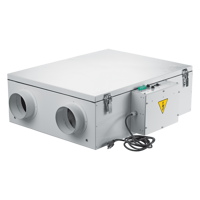
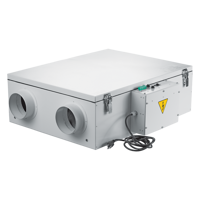
Designed for ceiling or wall mounting with side-by-side duct connections. The current generation includes the new ERV EC D 130 and HRV EC D 130 — compact, high-efficiency residential ERV systems with counterflow cores and EC motors. For installations where a new unit isn’t required, the proven ERV D(R) and HRV D(R) series with cross-flow cores cover airflows from 80 to 150 CFM and have a long installation track record in North American homes.
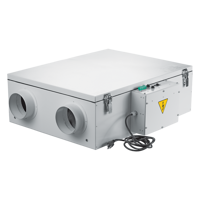
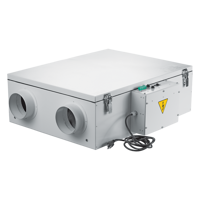
These fresh air ventilators work well in utility rooms or attic spaces where ceiling height is limited. The new ERV EC L 150 and HRV EC L 150 feature compact horizontal housing with side-by-side duct connections, suitable for wall or ceiling mounting.
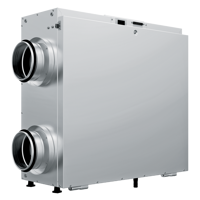
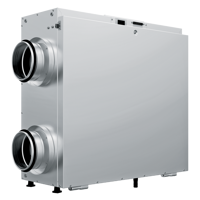
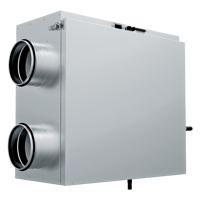
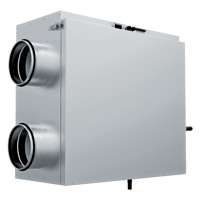
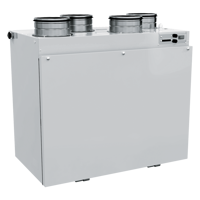
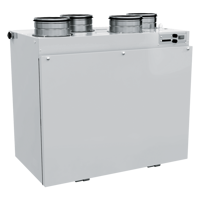
Vertical units use top air duct connections and install against a wall or on the floor — useful when vertical duct runs make more sense than horizontal ones in the building layout. This format covers larger homes and scenarios where the HRV ERV system integrates with a more extensive duct network.
The deciding factor between a residential HRV and a residential ERV isn’t preference — it’s the climate the home is in.
A residential HRV handles heat recovery ventilation only. In cold climates — Canadian provinces, the northern US states — homes accumulate excess indoor humidity in winter from cooking, bathing, and occupant activity. An HRV removes that moisture along with stale air while still recovering most of the heat, keeping walls and windows free from condensation.
A whole house ERV handles both heat and moisture transfer. In drier climates, or in tightly sealed homes where indoor humidity drops below comfortable levels in winter, a residential ERV system retains enough moisture without requiring a separate humidifier. In summer, the same moisture transfer reduces the latent load on air conditioning.
Airflow requirements are based on floor area, number of bedrooms, and the applicable ventilation standard (ASHRAE 62.2 in North America). As a general reference for sizing a residential ERV system or air handling unit for home:
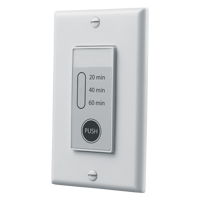
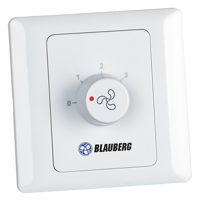
Available residential controls include a 20/40/60 push button timer (S52), a wall speed controller (CDP-3/5), and a full wall control panel (AC208EM2+LP). These options suit different installation scenarios — from simple timer-based operation in smaller homes to more advanced panel management in larger properties.
A home air handling unit is a mechanical ventilation system that continuously exchanges indoor air with filtered fresh outdoor air while recovering most of the heat from the exhaust stream. It connects to the home’s duct system and runs year-round to maintain healthy indoor air quality.
A residential ERV system is a whole-house energy recovery ventilation unit that supplies fresh filtered air while exhausting stale indoor air, recovering both heat and moisture in the process. Unlike a standalone exhaust fan or a central AC system, an ERV system maintains indoor humidity at a comfortable level year-round and addresses CO₂ buildup, odors, and airborne pollutants that recirculating systems cannot.
Both recover heat. A residential HRV transfers heat only and is best for cold climates where removing excess winter humidity is the priority. A residential ERV also transfers moisture, making it better for dry or mixed climates where maintaining humidity in winter matters.
Yes — they serve different functions. Central AC recirculates existing indoor air. A residential HRV or ERV provides the fresh outdoor air exchange that AC systems don’t, addressing CO₂ buildup, odors, and airborne pollutants independently.
An ERV HVAC unit recovers both heat and moisture, making it ideal for mixed and dry climates or tightly sealed homes. An HRV recovers heat only and is preferred in cold climates where excess indoor humidity needs to be expelled. Both function as a whole house ventilation system — the choice depends on climate and humidity profile.
Blauberg residential units are available in suspended (ceiling/wall), horizontal (wall/ceiling), and vertical (wall/floor) configurations to suit different utility room layouts and installation constraints.