/ Product catalogue / Decentralized HRV / ERV
There are situations where running ductwork through a building simply isn’t practical. An older apartment with concrete walls, a school classroom in a renovated wing, a home office built into a garage — in all of these cases, stale air builds up with no easy path out. A ductless ERV system or single room HRV is often the most direct solution: one wall penetration, no duct runs, and the room gets continuous fresh air with heat recovery.
Decentralised ventilation is a design approach where each unit serves its own space independently, rather than distributing air from a central HRV system through a duct network. A ductless HRV or single room ERV mounts directly in the wall and acts as a self-contained air exchanger: both supply and exhaust pass through the heat exchange element inside the unit without mixing.
The practical advantage in retrofit scenarios is significant: no changes to the rest of the building’s ventilation, no coordination with mechanical rooms, and no structural modifications beyond a core hole in the exterior wall. The through wall ERV handles everything — supply, exhaust, and heat recovery — within a single compact unit.
The single-room HRV and ERV catalog is organized into three families by airflow capacity and application type.
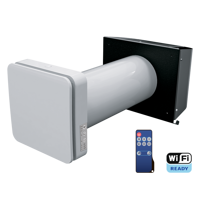
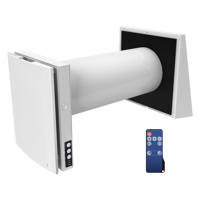
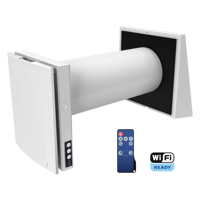
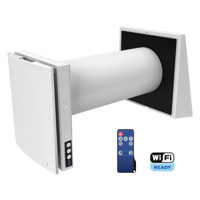
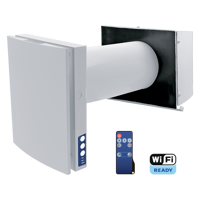
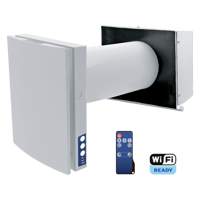
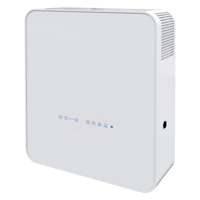
VENTO is designed for bedrooms, home offices, and individual apartments. Available models include the Vento Expert A50-1 W (15 CFM with Wi-Fi), the Vento Expert A85-1 W (25 CFM with Wi-Fi), and the Vento Expert A100-1 S W (32 CFM with Wi-Fi). For two-room installations or spaces needing balanced dual-direction airflow, the Vento Expert DUO A30-1 S W provides 18 CFM with dual-flow operation.
For Canadian winters and northern US climates, the Vento Expert A50C3-1 W is the cold climate version with integrated freeze protection. VENTO units use a ceramic regenerative core that alternates between intake and exhaust cycles, storing and releasing heat with each pass. Heat recovery efficiency reaches up to 97%.
VENTO units also work as a wall mounted ERV for bathrooms and utility rooms where moisture control matters — the ceramic core handles humidity passively without adding mechanical complexity.
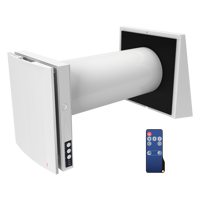
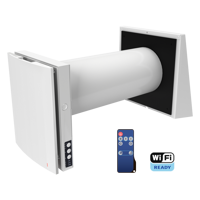
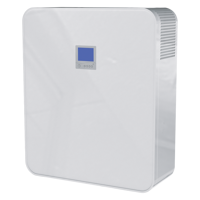
FRESHBOX covers larger individual rooms and small apartments. The Freshbox 100 WiFi and Freshbox 100 are compact wall-mounted single room heat recovery units. The Wi-Fi version supports remote speed and schedule control via smartphone without physically accessing the unit. FRESHBOX is also the best ductless ERV option for a bathroom ERV installation — its compact housing fits standard wall openings and handles both ventilation and heat recovery in a single step.
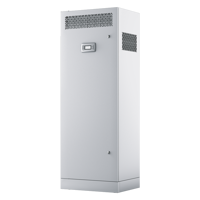
CIVIC EC series units are designed specifically for ductless ventilation in commercial and institutional spaces with strict noise requirements — classrooms, libraries, conference rooms, and open-plan offices. Despite airflow up to 341 CFM, operating noise runs from just 22 to 35 dBA. The CIVIC EC LB 300 delivers 188 CFM at 123W with MERV8 extract and MERV8+MERV14 supply filtration. The larger CIVIC EC LB 500 reaches 341 CFM with heat recovery core efficiency between 82 and 97% and handles outdoor air temperatures from −13°F to +122°F.
The split between a single room HRV and a ductless ERV follows the same logic as whole-home systems, applied at the room level:
A single room HRV uses a sensible-only core — it transfers heat without moisture. This works well in cold climates where the room naturally generates enough humidity from occupants, plants, or nearby cooking, and where removing excess winter moisture is the goal.
A ductless ERV uses an enthalpy core that transfers both heat and moisture. In spaces that tend to dry out — a well-sealed bedroom, a low-occupancy office in a dry climate, or a bathroom ERV installation — the ductless ERV system keeps humidity at a stable level without running a separate humidifier.
VENTO units use a ceramic regenerator that operates in alternating cycles: warm stale air flows through the core and deposits its heat, then the direction reverses and incoming fresh air picks up that stored energy. This cycle-based operation achieves high recovery efficiency in a compact, wall-mounted room ventilator form factor.
A ductless ERV is a wall-mounted ventilation unit that serves a single room without connecting to any duct system. It draws stale air out and brings fresh air in through a single wall sleeve, using an internal energy recovery core to transfer both heat and moisture between the two streams.
The best ductless ERV depends on room size and climate. For bedrooms and small rooms up to 32 CFM, VENTO units offer Wi-Fi control and up to 97% heat recovery efficiency. For larger rooms and open plans, FRESHBOX covers 18 to 59 CFM. For cold climates, the Vento Expert A50C3-1 W includes integrated freeze protection. CIVIC units cover commercial and institutional spaces at up to 341 CFM.
Both recover heat. A single room HRV transfers heat only — better for cold climates where winter moisture removal matters. A single room ERV also transfers moisture — better for dry climates or rooms where maintaining humidity in winter is the priority.
Decentralised ventilation means each room has its own independent ventilation unit rather than sharing air from a central HRV system via ducts. Each ductless HRV or ERV handles one space, which simplifies installation in retrofit projects and gives occupants room-level control over airflow.
Yes. The CIVIC EC series is specifically designed for classrooms, libraries, offices, and conference rooms — with airflow up to 341 CFM and noise starting at 22 dBA, requiring no ductwork.
Yes. A through wall ERV or wall mounted ERV recovers heat from the exhaust air rather than simply venting it outside, making it significantly more energy-efficient than a standard bathroom exhaust fan. VENTO and FRESHBOX units are compact enough for most bathroom wall installations and handle both ventilation and moisture control in a single step.
VENTO units support a coordinated network of multiple units with central control, allowing synchronized operation across several rooms from a single point.